
Pin Collecting
How to Identify an Official Blizzard Pin
Official, Licensed, Fan-Made & Everything In Between
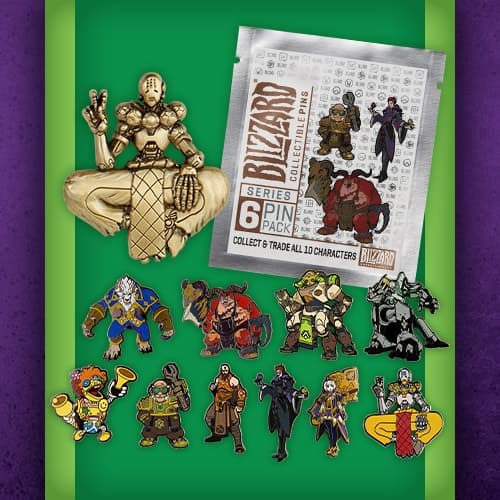
The Rule to Remember
Official = Blizzard-produced OR officially licensed by Blizzard Entertainment
You find a great-looking World of Warcraft pin online.
It has Arthas on it.
It looks professionally made.
The seller calls it a "Blizzard pin."
So it must be an official Blizzard collectible... right?
Not necessarily.
There are thousands of Blizzard-themed pins in circulation, and not all of them were actually produced or authorized by Blizzard Entertainment.
Some are official Blizzard releases.
Some were created by companies working under an official Blizzard license.
And many others are fan-made pins created by independent artists.
All of those pins can be fun to own.
All of them can be collectible.
But they are not the same thing.
If you're building an official Blizzard pin collection, knowing the difference is one of the most important skills you can learn.
What Makes a Pin an Official Blizzard Pin?
For BlizzardItems, we use a simple definition:
An official Blizzard pin is a pin that was either produced by Blizzard Entertainment or produced under an official license from Blizzard Entertainment.
That gives us two major categories of official pins.
Blizzard-Produced Pins
These are pins produced or commissioned directly by Blizzard, including releases from Blizzard's collectible pin program, BlizzCon, Blizzard Gear, promotions, esports events, employee programs, collector's editions, and other official Blizzard channels.
Officially Licensed Pins
Blizzard doesn't necessarily manufacture every official collectible itself. Other companies may produce merchandise under an official Blizzard Entertainment license. If Blizzard authorized the product, we consider it an official Blizzard pin.
The key word is authorized.
It isn't about which factory made the pin. It's about whether Blizzard Entertainment authorized the product.
What Is a Fan-Made Blizzard Pin?
A fan-made pin is created independently by an artist or company using characters, imagery, themes, or inspiration from Blizzard games without being part of Blizzard's official collectible program or an officially licensed Blizzard product line.
And there are some really good fan-made pins.
Teaberry House, also associated with the artist Tsepish, is one of the better-known examples within the Warcraft collecting community.
Their designs include Warcraft characters, pets, mounts, creatures, and other game-inspired artwork.
Many Blizzard collectors own them.
Some actively collect them.
They can be beautifully designed, professionally manufactured, limited in quantity, and highly desirable.
But unless a particular release was officially licensed by Blizzard, it is still a fan-made pin, not an official Blizzard pin.
That distinction isn't a criticism of the artwork.
It's simply a classification.
Fan-Made Does Not Mean Fake
This distinction is important.
Official Pin
Produced by Blizzard or under an official Blizzard license.
Fan-Made Pin
An independent Blizzard-inspired design that is not part of Blizzard's official or licensed catalog.
Counterfeit / Fake
A reproduction intended to imitate an existing official pin and potentially be mistaken for the genuine item.
A fan artist creating their own interpretation of a Warcraft character is very different from someone deliberately manufacturing a copy of an existing Blizzard pin and trying to pass it off as genuine.
A collector may knowingly pay good money for a fan-made Teaberry House pin because they love the artwork.
There's nothing confusing about that if everyone knows what it is.
The problem comes when an unofficial or counterfeit pin is represented as an official Blizzard release.
Why Does the Distinction Matter?
Cataloging
If you're trying to build a complete official Blizzard collection, fan-made pins aren't part of that checklist.
Rarity
A limited fan-made release of 50 pieces may be much scarcer than an official Blizzard pin. That still doesn't make it an official pin.
Value
Fan-made pins can absolutely have secondary-market value, and some may sell for more than many official Blizzard pins. They just belong to a different collector market.
Trading
Collectors often trade both official and fan-made pins. The important thing is that both people understand what they're trading.
Historical Documentation
BlizzardItems is documenting Blizzard's official and officially licensed collectible history, so distinguishing those items from independent fan creations matters.
So How Can You Tell?
Unfortunately, there isn't one magic test.
You can't simply look at the front of every pin and instantly know whether it's official.
Instead, identification usually comes from combining several clues.
1. Check the Back of the Pin
This is usually one of the first things you should do.
Flip it over.
Official Blizzard pins frequently contain clues such as:
- Blizzard Entertainment markings
- Blizzard logo or copyright information
- Game or franchise copyright information
- Manufacturer information
- Licensing information
- Series or product markings
- Edition information
The exact markings vary considerably by era and manufacturer.
No Blizzard logo does not automatically mean fan-made
Older pins, unusual promotional items, event releases, and licensed merchandise may have different markings than modern Blizzard pins. Never classify a pin based on one feature alone.
2. Look for Copyright & Licensing Marks
Official merchandise often includes some form of copyright, trademark, manufacturer, or licensing information.
You may see wording associated with Blizzard Entertainment or the relevant game or franchise.
Officially licensed merchandise may also identify the company that manufactured the product.
Use those markings as evidence, not as the only test.
3. Check the Original Packaging
If the pin still has its original packaging or backing card, identification can become much easier.
Look for:
- Blizzard branding
- Blizzard Gear branding
- BlizzCon branding
- Official game logos
- Copyright notices
- Licensed manufacturer information
- Product labels
- UPC or SKU information
Original packaging can also help identify where a pin came from, which is often just as useful as identifying the design itself.
Of course, plenty of genuine pins have long since been separated from their packaging.
Missing packaging does not mean the pin is unofficial.
4. Identify Where the Pin Originally Came From
This is one of the strongest pieces of evidence.
How was this pin originally distributed?
Maybe it came from:
- A Blizzard Gear Store purchase
- BlizzCon
- A Blizzard collectible pin series
- San Diego Comic-Con
- PAX
- Gamescom
- An esports event
- A collector's edition
- An employee program
- A Blizzard promotional event
- An officially licensed merchandise company
If you can establish the original source, identification becomes much easier.
That's why BlizzardItems tracks Originally Obtained From whenever we know it.
5. Search the BlizzardItems Database
This is one of the reasons we built BlizzardItems.
If you have a pin you don't recognize, search for it.
Try:
- Character name
- Franchise
- Series
- Event
- Logo
- Approximate year
If you find a matching design, compare:
- Image
- Release date
- Series
- Rarity
- Originally obtained from
- Description
- Other known information
If the exact pin exists in the BlizzardItems database, that's a very strong starting point because our pin catalog is focused on official Blizzard and officially licensed releases.
Browse the Blizzard Pin Database →6. Don't Trust the Listing Title
This is especially important when shopping through online marketplaces.
A listing called:
"RARE WORLD OF WARCRAFT BLIZZARD PIN"
doesn't establish anything.
Sellers may use words like:
- Blizzard
- Warcraft
- WoW
- Diablo
- Overwatch
- Official
- Rare
- Limited
because those words help people find the listing.
Sometimes the seller genuinely doesn't know what they have.
Sometimes they copied another listing.
Sometimes they're using "Blizzard pin" simply to mean a pin featuring something from a Blizzard game.
Always look beyond the title.
7. Recognize Common Fan-Made Artists
As you spend more time collecting, you'll start recognizing certain fan artists and manufacturers.
Teaberry House / Tsepish is a good example.
Their Warcraft-inspired pins have a distinct artistic style and are popular within the fan community.
Seeing one doesn't mean:
"Oh, that's fake."
It means:
"That's a Teaberry House fan-made pin."
Learning the fan-made side of the hobby can actually make you better at identifying official pins, because you'll start recognizing which designs belong to which creators.
8. Style Alone Isn't Enough
You may eventually look at a pin and think:
"That doesn't look like a Blizzard pin."
Maybe.
But Blizzard has released pins over many years, through many manufacturers, events, promotions, and licensing partners.
The styles vary enormously.
Meanwhile, fan-made artists can produce pins at extremely high manufacturing quality.
Appearance alone can fool you
Professional-looking does not automatically mean official, and unusual-looking does not automatically mean unofficial. Research beats intuition.
Officially Licensed Pins Can Be Tricky
This is probably the area that causes the most confusion.
Imagine a pin wasn't sold by Blizzard Gear.
It wasn't part of Blizzard's numbered pin program.
It wasn't sold at BlizzCon.
But another company produced it under a legitimate Blizzard Entertainment license.
Is it official?
Yes.
For BlizzardItems, authorization is what matters.
If Blizzard licensed the product, it belongs in the official collectible universe.
Packaging, copyright markings, archived product listings, catalogs, manufacturer information, and other documentation can help establish whether a third-party product was officially licensed.
What About Convention Giveaways?
Not every official Blizzard pin was something you could buy.
Pins have been distributed through:
- Booth activities
- Game demos
- Promotional events
- Press events
- Esports competitions
- Employee programs
- Convention giveaways
Some of these can be harder to document because they never had a normal retail product page.
That's where provenance becomes important.
If we can document that Blizzard or an authorized partner distributed the pin through an official event, that's meaningful evidence.
What About Employee Pins?
Employee pins can be some of the hardest items to identify.
They may have been created for:
- Internal teams
- Employee anniversaries
- Game launches
- Company events
- Holiday gifts
- Recognition programs
- Internal celebrations
Some were never intended for public sale, which means documentation may be limited.
For BlizzardItems, we try to distinguish between:
Confirmed Information
Release details supported by reliable documentation.
Collector Belief
Details that may be widely believed but still lack complete documentation.
If something is believed to be an employee item but we can't fully verify the history, we would rather say that than pretend certainty exists.
What About Counterfeits?
As collectible values rise, reproductions become more important to watch for.
A counterfeit attempts to imitate an existing official Blizzard pin.
Potential warning signs can include:
- Incorrect colors
- Poor enamel work
- Wrong metal finish
- Incorrect size
- Missing or incorrect back markings
- Strange fonts
- Low-quality printing
- Incorrect packaging
- Differences from known genuine examples
Manufacturing variations do exist
A slightly different color or finish is not automatically proof of a counterfeit. Whenever possible, compare the questionable pin directly with a known genuine example.
Fan-Made Pins Can Still Be Highly Collectible
This point deserves emphasis.
"This isn't an official Blizzard pin"
does not mean:
"This isn't worth collecting."
Those are completely different statements.
Independent artists have created some fantastic Blizzard-inspired pins.
Collectors may seek particular artists, limited releases, character sets, color variants, or discontinued designs.
Teaberry House is a good example of how a fan-made pin line can develop its own collector following.
Some collectors maintain separate displays:
Official Blizzard Collection
Blizzard-produced and officially licensed releases.
Fan-Made Collection
Independent artist and community-created releases.
Others mix everything together.
Both approaches are fine.
Just know what you're collecting.
A Quick Identification Checklist
1. Flip it over.
Look for Blizzard, copyright, manufacturer, or licensing information.
2. Check the packaging.
If it exists, look for official branding and product information.
3. Identify the character or design.
Knowing what you're looking at makes searching much easier.
4. Search BlizzardItems.
Look for an exact visual match.
5. Investigate where it originally came from.
Event, store, series, employee program, or licensed manufacturer?
6. Search the manufacturer or artist.
This can quickly reveal whether something came from an official licensee or independent creator.
7. Compare it with known genuine examples.
Especially if you're concerned about a counterfeit.
8. If you're still unsure, don't guess.
Sometimes the correct answer is simply: "We haven't identified this one yet."
The Most Important Rule
Featuring a Blizzard character does not make something an official Blizzard collectible.
An official Blizzard pin must have been produced by Blizzard Entertainment or produced under an official license from Blizzard Entertainment.
A professionally manufactured Arthas pin created by an independent artist can be beautiful, valuable, collectible, limited, and hard to find.
Collectors can love it.
Collectors can trade it.
Collectors can pay serious money for it.
But unless Blizzard authorized the product, it isn't an official Blizzard pin.
And that's perfectly okay.
It simply belongs to a different part of the collecting world.
Want to Learn More About Blizzard Pins?
If you're still getting familiar with Blizzard pin collecting, our beginner guide covers series, rarity, value, exclusives, storage, and building a collection.
Read Blizzard Pin Collecting 101 →One Last Piece of Advice
Don't think of official and fan-made as:
good versus bad.
Think of them as:
different categories with different histories.
An official Blizzard pin tells part of the story of Blizzard's merchandise, events, employees, games, and licensing history.
A fan-made pin tells part of the story of the community and the artists inspired by those games.
Both can be worth collecting.
The important thing is knowing which one you're holding.
And once you can do that?
You're no longer just looking at pins.
You're identifying them.
— BlizzardItems