
Patch Collecting
Blizzard Velcro Patch Collecting 101
A Beginner's Guide to Blizzard Patches
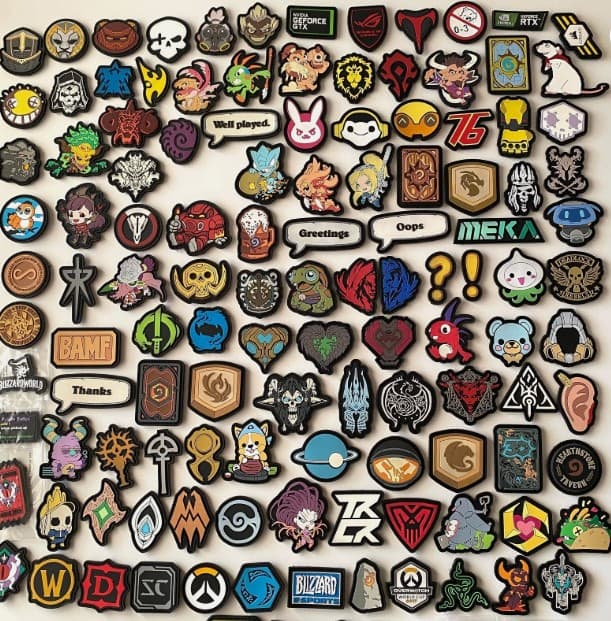
Maybe you saw a collector carrying a Velcro backpack covered in Blizzard logos.
Maybe you pulled one from a mystery capsule.
Maybe you found one at BlizzCon.
Or maybe you were browsing BlizzardItems and suddenly realized:
"Wait... Blizzard made this many patches?"
They did.
And Blizzard patch collecting has a history all its own.
Unlike Blizzard pins, which are often organized around numbered pin series, gold variants, and standalone collector releases, Blizzard patches developed around a different ecosystem: blind packs, capsule machines, starter sets, event activities, sponsor giveaways, official trading boards, employee items, and one-off patches you sometimes had to earn rather than buy.
That makes them one of the more interesting corners of Blizzard collecting.
Welcome to Blizzard patch collecting.
Heading to BlizzCon 2026?
Blizzard's 2026 Darkmoon Faire appears to represent a shift in the collectible lineup. New gachapon machines, capsule magnets and keychains, FiGPiN Mini Mystery pins, and other experiences are taking center stage, while Blizzard has not announced a new Velcro patch series.
This guide covers the broader history of Blizzard patch collecting. For what collectors should expect specifically at this year's Faire, see our 2026 collector strategy guide.
BlizzCon 2026 Darkmoon Faire Collector's Game Plan →Patches or Badges?
Let's clear up one piece of terminology first.
Blizzard has historically referred to many of these collectibles as badges, particularly when they were sold in products such as Badge Booster Packs.
Collectors commonly call them Velcro patches or simply patches.
On BlizzardItems, we use patches.
Whatever name you prefer, we're talking about the same general type of collectible: mostly vinyl-made Blizzard patches with Velcro-style hook-and-loop backs, designed to attach to compatible bags, boards, books, hats, and other displays.
A smaller number may use other materials or constructions, but vinyl is by far the most common format in the Blizzard patch catalog.
Unlike sew-on patches, they're meant to be moved.
Which turns out to be extremely convenient when you own 100 of them and decide your entire display needs to be reorganized at 11:30 at night.
The Modern Blizzard Patch Program
The BlizzardItems database shows the modern patch-collecting ecosystem really taking shape around 2017.
That year introduced several things that became important to the hobby:
- The first numbered blind-pack series
- A Blizzard Velcro backpack
- A six-patch starter set
- BlizzCon activity and giveaway patches
- Sponsor and booth patches
- Patches tied to specific games and experiences
The six-patch starter set is a particularly good example of how Blizzard approached the format.
It contained franchise logo patches for:
Those patches were sold with the Blizzard Velcro Backpack, giving collectors both something to display and a group of patches to start with.
And then came the blind packs.
The Five Numbered Patch Series
One of the clearest ways to understand Blizzard patch collecting is through the numbered series.
The BlizzardItems database currently tracks five major blind-pack series:
Together, these account for 89 patches in the BlizzardItems database.
These series mixed characters, logos, icons, factions, card backs, creatures, and other designs from Blizzard franchises.
Series 1
- • Diablo (Red)
- • Alliance Crest
- • Protoss Logo
- • Zergling
Series 2
- • Zandalari Logo
- • Blackwatch Logo
- • Blaze
- • Hearthstone Mug
Series 3
- • Pachimari
- • Nova
- • Random Card Back
- • Murgle
Series 4
- • Night Fae
- • Genji Ult
- • Purple Nexus Pal
- • Year of the Phoenix
Series 5
- • Helm of Domination
- • Death Knight Crest
- • All Seeing
For a new collector, these numbered series are probably the easiest place to start.
Instead of trying to understand every Blizzard patch ever released, you can simply say:
"I'm going to work on Series 3."
Now you have a defined set.
And a checklist.
And eventually one patch that is somehow much harder to find than all the others.
Welcome to collecting.
Blind Packs Explained
Blind packs were one of the core ways Blizzard distributed patches.
You purchased a pack without knowing exactly which patch was inside.
That randomness is part of what made the series fun.
It also created the inevitable collector problem:
duplicates.
You might open three packs and pull two patches you already own.
Or get a Warcraft patch when you're trying to complete an Overwatch group.
That's where collecting naturally begins to overlap with trading.
But even if you never trade a single patch, blind packs are important because they define some of the biggest organized sets in the hobby.
Capsule Machine Patches
Blind packs were not the only randomized way to get Blizzard patches.
Blizzard also released a large number through capsule toy machines.
The BlizzardItems database currently contains 33 patches specifically documented as capsule toy prizes.
These are especially prominent in the 2018, 2019, and 2023 BlizzCon-era releases.
Examples include:
Blind packs and capsule patches are different groups
A collector might work toward completing a numbered series while separately collecting capsule-machine releases from a particular BlizzCon.
BlizzCon 2026 Update
Capsule machines are returning to the Darkmoon Faire for BlizzCon 2026, but patches do not appear to be the primary capsule collectible this year.
Blizzard's newly announced Trading Post includes dedicated boards for Capsule Magnets and Capsule Keychains, strongly suggesting those are major physical prizes coming from the new gachapon machines.
That would represent a notable change from recent BlizzCons, where exclusive Velcro patch sets were the standard capsule collectible.
Blizzard has not yet published a complete 2026 capsule prize checklist, so we'll update this guide once the full prize lineup is confirmed.
The Patches You Had to Earn
This may be the most interesting part of Blizzard patch collecting.
Not every patch came from a store.
Some had to be earned.
Or found.
Or unlocked by participating in something.
Cosplay
The 2017 Cosplay patch was available through the Cospitality room and required the attendee to actually be in cosplay.
Nvidia
BlizzCon Nvidia patches were tied to completing an Emissary Quest.
ASUS ROG
Some patches came from ASUS ROG vending machines near the World of Warcraft play area.
Lil' Ragnaros
The 2017 Lil' Ragnaros patch was obtained through the Heroes of the Storm demo.
Talon Logo
The Talon Logo patch was connected to testing BlizzWorld, the Overwatch demo experience at BlizzCon 2017.
MSI Lucky Dragon
The MSI Lucky Dragon patch required attendees to register for MSI's mailing list.
HyperX
The 2019 HyperX patch required attendees to visit multiple photo locations, complete a survey, and register for the mailing list.
The story behind a patch can be part of what makes it collectible.
Two patches might both be from 2017, but one was sold in a blind pack while the other required someone to complete an activity at one particular convention.
That distribution history matters.
Sponsor & Booth Patches
BlizzCon exhibitors and partners also contributed their own patches to the ecosystem.
These weren't necessarily produced as part of Blizzard's numbered series.
Instead, they might have been connected to a booth, promotion, activity, or sponsor campaign.
Examples include:
For collectors, these can be especially interesting because they represent a specific moment in BlizzCon history rather than simply a character or game.
Darkmoon Faire Patches
The Darkmoon Faire became another important part of the patch ecosystem.
Some patches were directly connected to the Faire.
The 2017 Darkmoon Faire patch in the BlizzardItems database, for example, was obtained by purchasing something at the Darkmoon Faire.
Other patches reached collectors through Faire activities, mystery systems, capsules, and official trading boards.
That makes the Faire important for two reasons:
It was a source of patches.
And it was a place where patches already in circulation changed hands.
BlizzCon 2026 Update
For BlizzCon 2026, Blizzard's newly announced Darkmoon Faire lineup puts more emphasis on magnets, keychains, FiGPiNs, plushies, and digital rewards.
Blizzard has not announced a new 2026 Velcro patch series.
That doesn't mean patches won't appear somewhere at BlizzCon, but collectors should not assume the capsule machines will once again contain the exclusive patch set seen at recent conventions.
Official Blizzard Patch Trading Boards: A Look Back
Blizzard's official trading boards played a surprisingly interesting role in patch collecting.
At previous BlizzCons, collectors could exchange eligible patches for ones displayed on Blizzard's board according to that year's rules.
Because every trade changed the board, the selection could change constantly.
Some unusual patches also appear to have entered circulation through those boards.
The BlizzCon 2019 Square
According to the BlizzardItems database, this patch appeared on the BlizzCon 2019 trading board. Blizzard employees were also reportedly randomly attaching them to attendees' backpacks.
Imagine getting home from BlizzCon and discovering you had acquired a collectible without realizing it.
That's a very Blizzard way to distribute a patch.
BlizzCon 2026: No Dedicated Patch Board Announced
Blizzard has announced a redesigned Trading Post for the 2026 Darkmoon Faire.
The four official trading boards announced for 2026 are:
- FiGPiNs Mini Set
- Select Vintage Pins
- Capsule Magnets
- Capsule Keychains
Blizzard has not announced a dedicated Velcro patch or badge trading board for BlizzCon 2026.
Collectors can still trade patches directly with one another, but based on Blizzard's currently published Faire information, patches will not have their own official Trading Post board this year.
Employee Patches
Then we get into one of the more specialized parts of Blizzard collecting.
Employee patches.
These were created for or distributed through Blizzard employee programs rather than normal public retail channels.
Tristram
The Tristram patch was given to employees as part of the 2021 holiday gift and came with an employee version of the Velcro backpack.
Blizztern Program
The Blizztern Program patch was given to select employees connected with the Blizzard intern program.
Employee Rifleman & Employee Bear
These patches were very rarely seen on the BlizzCon 2019 trading board and are believed to have been employee-only releases.
Documentation matters
When a release history is incomplete, it's better to say "believed to be employee-only" than to turn collector speculation into fact.
For advanced collectors, employee patches can become a collection of their own.
For beginners?
Don't feel like you need them.
What Makes a Blizzard Patch Rare?
Patch rarity is heavily influenced by how the patch was distributed.
Consider the difference between:
- A patch sold in thousands of blind packs
- A capsule prize available at one BlizzCon
- A patch given out after completing a booth activity
- An employee holiday gift
- A patch that only occasionally appeared on an official trading board
Production Quantity
If very few were made, supply is naturally limited.
Distribution Method
Blind pack, capsule machine, activity reward, employee item, and retail release can all create very different levels of availability.
Availability Window
A patch available for one weekend is different from one sold online for months.
Geographic Availability
Some event and promotional items were only available in a particular place.
Collector Retention
Some patches disappear quickly into permanent collections and rarely return to the market.
Demand
A common patch featuring a popular character may be harder to buy than a technically rarer patch nobody is actively hunting.
Rare Doesn't Automatically Mean Valuable
Rare and valuable are related—but they aren't the same thing.
Supply + Demand + Condition + Availability
A patch can have low production but very little collector demand.
Another patch may have been produced in larger numbers but feature a popular character, franchise, iconic logo, or particularly desirable design.
That second patch may command the stronger market.
How Do I Know What a Patch Is Worth?
Patch pricing can be difficult because some patches simply don't sell very often.
If a rare employee patch hasn't changed hands publicly in two years, there may be very little current market data.
That's why we separate:
Asking Price
Actual Sale Price
Someone listing a patch for $300 doesn't make it a $300 patch.
It means someone wants $300.
When possible, look for:
- Recent completed sales
- Multiple sales instead of one
- How often the patch appears
- Condition
- Release history
- Current collector demand
- Comparable patches
Sometimes there simply isn't enough information.
And in those cases, "No recent market history" is better than pretending we know.
How Do I Identify a Blizzard Patch?
This can be more difficult than identifying a pin.
Many patches don't have obvious identifying information on the front.
A random logo might be:
- Part of a numbered blind-pack series
- A capsule release
- A booth giveaway
- An employee item
- A BlizzCon activity reward
- Part of a starter set
The Design
Character, faction, logo, event branding, or sponsor markings can provide the first clue.
Approximate Year
Knowing whether something appeared around 2017 versus 2023 can narrow the possibilities dramatically.
Series
If it belongs to Series 1–5, that immediately gives you a defined collecting group.
How It Was Obtained
Blind Pack, Capsule Toy Prize, BlizzCon, Employee Item, Goodie Bag, sponsor booth, and other distribution details are extremely useful for identification.
Condition Matters
Patches are durable, but they're not indestructible.
Look for:
- Scratches or scuffs on the vinyl surface
- Creasing
- Warping
- Discoloration
- Damaged printing or artwork
- Peeling layers
- Edge wear
- Damaged Velcro backing
- Missing original packaging, when relevant
A patch displayed on a backpack for years may look very different from one that immediately went into a collector's book.
That doesn't automatically make it bad.
Some collectors love items that were actually used.
Others want pristine examples.
Just know what you're buying.
Displaying Blizzard Patches
Velcro Backpacks
These are part of the history of the Blizzard patch program itself. They gave collectors a portable display surface while encouraging the collect → display → trade → rearrange ecosystem.
Velcro Display Boards
Perfect for home collections and easy organization by game, set, year, or theme.
Patch Books
Great for larger collections or anything you want to keep portable.
Wall Displays
A larger loop-fabric or Velcro-compatible panel can turn the collection into wall art.
Hats & Bags
Patches are made to be attached to things. Just remember that anything you wear regularly has a greater chance of getting dirty, damaged, or lost.
Maybe protect the truly rare ones
An impossible-to-replace employee patch probably doesn't belong on your everyday backpack.
How Should I Organize My Collection?
By Series
By Franchise
By Distribution Type
By Event
By Character or Theme
By 'This Looks Better Here'
Do I Need to Collect Everything?
Absolutely not.
The BlizzardItems database alone contains more than 170 documented patches.
Trying to collect everything from day one would be a very fast way to make the hobby feel impossible.
Start with something manageable.
That's enough.
Catalog Your Patch Collection
Patch collecting gets complicated surprisingly quickly.
Especially once you're dealing with:
- Five numbered series
- Capsule releases
- Event patches
- Employee items
- Sponsor patches
- Starter sets
- Activity rewards
Eventually you'll see something and think:
"Do I own this already?"
That's exactly why we built the BlizzardItems patch database.
You can use BlizzardItems to:
- Browse Blizzard patches
- Search by name
- Browse by franchise
- See series information
- View release years
- See how a patch was originally obtained
- Identify unusual releases
- Track your collection
- Keep track of what you're missing
A Beginner's Blizzard Patch Collecting Game Plan
1. Browse the BlizzardItems Patch Database.
Get a feel for what's actually out there.
2. Look at Series 1–5.
They're the easiest organized sets to understand.
3. Pick a focus.
A series, franchise, event, capsule set, or simply designs you like.
4. Start small.
You don't need an entire wall of patches to be a collector.
5. Get a Velcro display surface.
This is where patches really become fun.
6. Learn how a patch was distributed.
Blind pack, capsule, employee item, activity reward, and booth giveaway can mean very different things.
7. Don't assume asking price equals value.
Look for actual market history when possible.
8. Catalog your collection early.
Don't wait until you own 100 patches.
9. Let the collection evolve.
You might start with Warcraft and somehow end up obsessed with obscure 2017 booth patches. That is completely normal.
Pins or Patches?
Eventually somebody asks:
Which should I collect?
Pins have enormous variety, long-running series, special variants, and a huge collector history.
Patches have their own appeal.
They're lightweight.
Easy to display.
Easy to rearrange.
And because so many Blizzard patches were tied to specific activities, events, employees, capsules, and giveaways, they often have fantastic stories behind them.
There's also another option:
Collect both.
We're sorry.
Read Blizzard Pin Collecting 101 →One Last Piece of Advice
Collect the story as much as the object.
A Warcraft logo patch from a starter set is cool.
A patch you had to earn by completing an Emissary Quest is cool for a completely different reason.
An employee patch has another story.
A capsule patch another.
A patch that someone at Blizzard secretly stuck onto an attendee's backpack?
That's exactly the kind of weird little piece of Blizzard history that makes this hobby fun.
So don't worry about building the "best" collection.
Build one that makes you want to explain every patch on the board.
"This one came from a blind pack."
"This one was from a capsule machine."
"This one you could only get by doing a quest."
"And this one... nobody is entirely sure where it came from."
That's a collection.
Welcome to Blizzard patch collecting.
— BlizzardItems